

 Facebook
 X
 Pinterest
 Copy Link
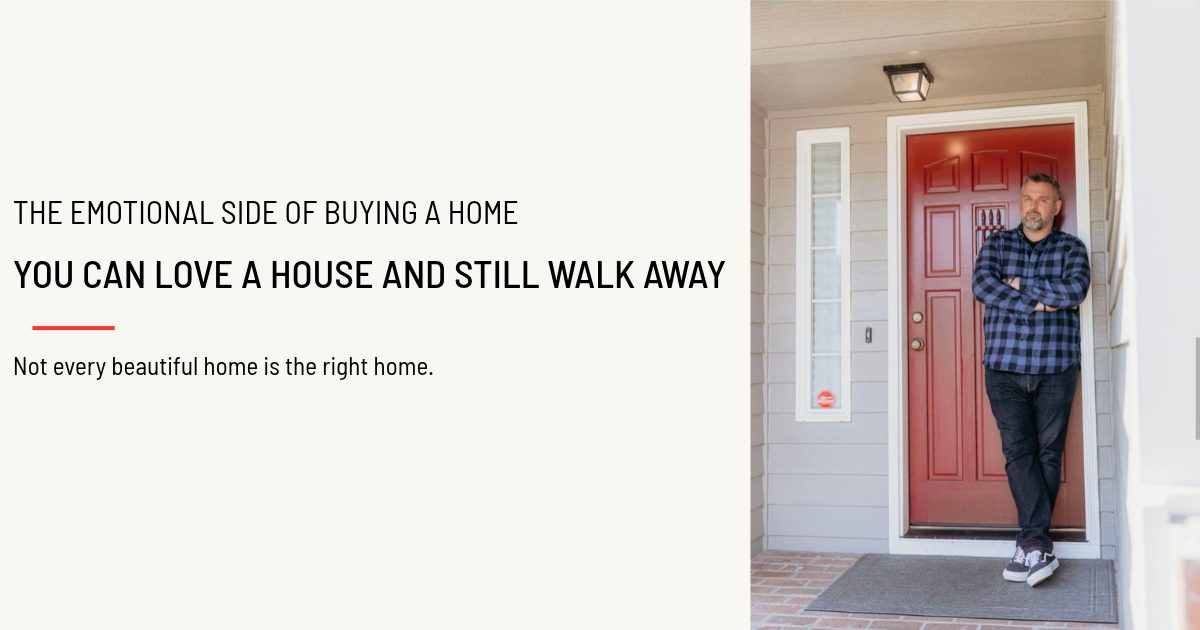
Not every beautiful home is the right home. Here’s how to recognize the difference before making one of the biggest purchases of your life.
There’s a moment that happens during some home showings when you can practically see a buyer falling in love.
Maybe it’s the architecture. The view. The natural light coming through the windows. Or that feeling when you walk through the front door and immediately start imagining your life there.
I’ve seen it happen plenty of times.
And honestly? I love those moments.
Buying a home should be exciting. It’s not just a financial transaction. You’re choosing where you’ll spend your mornings, where you’ll unwind after work, where your dogs will run around, and where some of your favorite memories might happen.
But sometimes, even when you absolutely love a house, the smartest decision is to walk away.
And that’s okay.
The Difference Between Loving a House and Living in It
Recently, I toured a couple of very different properties with buyers here in the Olympia area.
One checked a surprising number of boxes on paper. Great location, functional layout, and features that aligned with what they needed.
Unfortunately, the presentation left a lot to be desired.
The other property was something special. Beautiful architecture, incredible character, and the kind of Pacific Northwest atmosphere that makes you want to sit down, look out the window, and forget about the rest of the world.
It was the kind of house you could fall in love with almost immediately.
But there were compromises.
Not little things like paint colors or outdated fixtures. Things that would affect everyday life. Parking limitations. Outdoor space that didn’t fit their needs. Features that weren’t realistically going to change.
And that’s where the conversation shifted.
Because there’s a difference between admiring a house and imagining what it would actually be like to live there.
The first is emotional.
The second is practical.
A good home purchase needs room for both.
Some Problems Are Fixable. Others Come With the Property.
One of the most useful things buyers can do during a showing is separate a property’s problems into two categories.
Things you can change:
- Paint colors, flooring, and outdated finishes
- Landscaping and general cleanup
- Fixtures, appliances, and cosmetic updates
- Certain repairs or improvements, depending on cost and feasibility
Things that may be difficult or impossible to change:
- Lot size and usable outdoor space
- Shared driveways and access limitations
- The property’s location and surrounding development
- Parking constraints
- Certain floor-plan limitations
- Waterfront restrictions, setbacks, and environmental constraints
That doesn’t mean you should ignore the first category. Repairs can be expensive, and apparent cosmetic issues sometimes point to larger problems.
But there’s an important distinction between a house that needs work and a house that simply cannot accommodate the way you live.
A dirty house can be cleaned.
A dated kitchen can be remodeled.
Creating another half-acre of usable yard? That’s a considerably different conversation.
And if a property has limitations that would frustrate you every single day, those frustrations probably aren’t going to disappear just because you love the view.
The Best-Looking House Isn’t Always the Best House
This is also why presentation matters so much when selling a home.
Buyers are emotional creatures. Even the most analytical buyers form impressions within minutes of arriving at a property.
A clean, well-maintained home makes it easier to recognize its potential.
A poorly presented home can make buyers question its condition, even when the underlying layout and location are excellent.
Here in Thurston County, that can be especially relevant for acreage properties.
A home might have a fantastic floor plan, a detached shop, privacy, and usable land. But if the property looks neglected, outbuildings are poorly maintained, or buyers encounter signs of pest activity, those concerns can overshadow everything else.
Some of those issues may be manageable. Others warrant professional inspection and further investigation.
Either way, presentation influences how buyers perceive the property before they’ve had a chance to fully evaluate it.
And sometimes a less glamorous house deserves a second look precisely because its shortcomings are easier to correct.
You Don’t Have to Buy Your Forever Home
Here’s something I think gets overlooked in conversations about buying real estate.
Not every house needs to be your forever home.
Maybe you’re buying your first home and expect to move in five years.
Maybe your kids are getting older, and your needs are changing.
Maybe you’ve always dreamed of living on the water, and you’d love to experience that lifestyle for a while.
Or maybe you want acreage today, knowing perfectly well that someday you’ll get tired of maintaining it.
There’s nothing wrong with buying a home for a particular chapter of your life.
In fact, I think that can be a healthy way to approach homeownership.
But a shorter ownership timeline doesn’t make practical concerns disappear.
And it doesn’t guarantee that the market will cooperate when you’re ready to sell.
If you’re buying a distinctive waterfront property, for example, remember that the same features that make it special to you might appeal to a smaller pool of future buyers.
You should be comfortable with the purchase even if appreciation is modest, selling takes longer than expected, or the market looks different five or ten years from now.
Enjoying a home is a perfectly good reason to buy it.
Relying on a future seller’s market to justify its shortcomings is a different story.
What Should You Compromise On When Buying a House?
Almost every buyer eventually faces some kind of compromise.
The trick is figuring out which compromises are reasonable and which ones could become expensive regrets.
Before making an offer, I encourage buyers to ask themselves a few questions:
Will this bother me occasionally, or every day?
An unusual bedroom layout might be manageable. A driveway that makes parking a daily headache could be a different matter.
Can I realistically change it?
Don’t assume you can add a garage, expand a driveway, clear trees, or build an addition without verifying what’s permitted.
What will it cost to fix?
Even manageable repairs need to make financial sense. Get qualified estimates rather than relying on wishful thinking.
Am I choosing this compromise, or convincing myself to accept it?
There’s a big difference.
And finally:
If the market doesn’t appreciate the way I hope, will I still be happy I bought this house?
That question deserves a little more attention than it usually gets.
Olympia-Area Buyers Have Some Unique Things to Consider
Homes around Olympia, Lacey, Tumwater, and the surrounding parts of Thurston County can offer some incredible lifestyles.
Waterfront retreats. Wooded acreage. Quiet rural roads. Properties with detached shops, barns, and room to spread out.
But those features also come with considerations that aren’t always obvious in listing photos.
A waterfront home may have limited parking or usable yard space because of its lot configuration.
A rural property may have access easements, private-road maintenance obligations, or restrictions affecting future improvements.
A beautiful wooded parcel may include wetlands, critical areas, or setbacks that limit what you can do with it.
And a detached shop that looks perfect in photos may deserve a closer look at its condition, permitting, and intended use.
None of those things automatically makes a property a bad purchase.
They simply deserve investigation before you commit.
That’s why I spend so much time helping buyers look beyond the listing photos and think through how a property will actually function.
Because the best home isn’t necessarily the one with the most impressive features.
It’s the one whose features make sense for your life.
Sometimes the Best Decision Is Not Making an Offer
One of the things I’ve learned working with buyers is that a showing doesn’t have to end with an offer to be productive.
Sometimes you discover a neighborhood you love.
Sometimes you realize a feature you thought was essential doesn’t matter nearly as much as you expected.
Sometimes a house you weren’t excited about on paper surprises you.
And sometimes you walk through an absolutely gorgeous home, fall in love with everything about it, and still recognize that owning it would create problems you don’t want to live with.
That’s not a wasted showing.
That’s progress.
I wrote recently about why I never wanted to be a salesman. A big part of that is believing my job isn’t to convince someone to buy a house.
It’s to help them make a decision they’ll feel good about long after the excitement of the showing wears off.
Sometimes that means writing an offer.
Sometimes it means scheduling another showing.
And sometimes it means standing in a beautiful house and saying, “I love it, too. But let’s talk about what living here would actually look like.”
The Right House Isn’t Always the One You Love Most
There’s nothing wrong with falling in love with a house.
In fact, I hope you do.
But I also hope you can recognize when the things you love about a property aren’t enough to outweigh the things you can’t change.
A home doesn’t have to be perfect.
It doesn’t have to be your forever home.
And it certainly doesn’t have to check every box on a spreadsheet.
It just needs to make sense for the life you want to live.
You can love a house and still walk away.
Sometimes that’s exactly the right decision.
Thinking about buying a home in Olympia, Lacey, Tumwater, or elsewhere in Thurston County? I’m always happy to help you sort through the possibilities, the compromises, and the occasional house that looks better in photos than it does in person. No pressure. Just an honest conversation.


