

 Facebook
 X
 Pinterest
 Copy Link
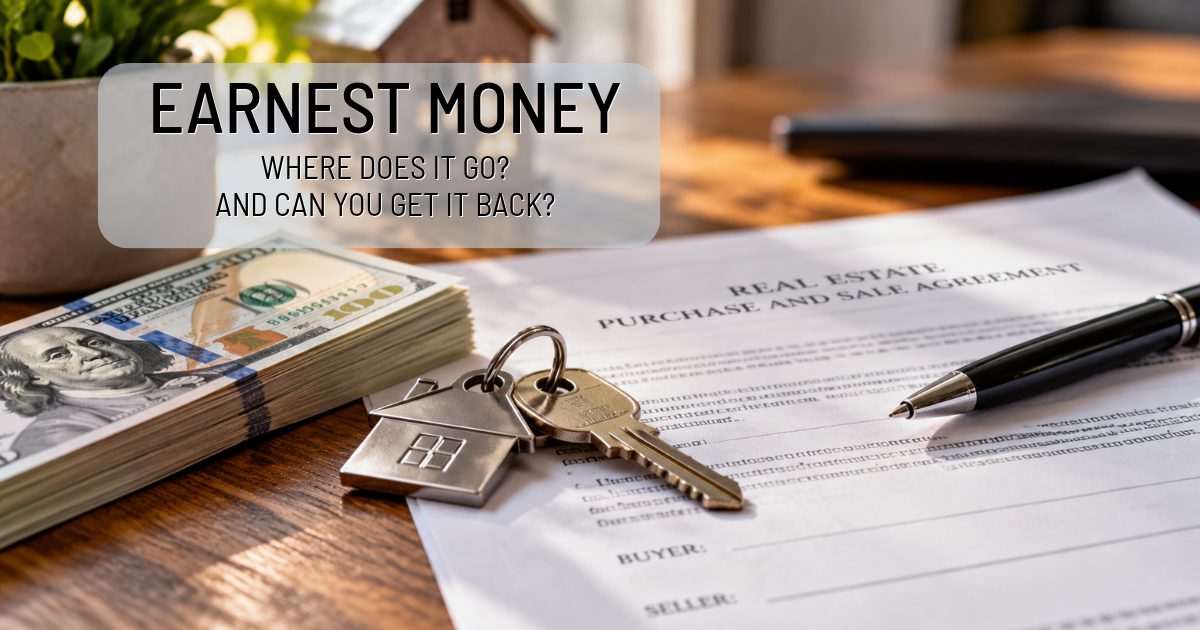
It’s not an extra fee for buying a house. But understanding when your money is protected—and when it isn’t—matters.
You’ve found a house you love. You’ve talked with your lender, figured out what you can afford, and you’re ready to make an offer.
Then your Realtor mentions earnest money.
Wait. You need to write a check before you actually buy the house?
Yep. Welcome to another part of the homebuying process that makes perfect sense once someone explains it, but sounds a little ridiculous the first time you hear it.
Let’s talk about what earnest money actually is, where it goes, and what happens if your purchase doesn’t work out.
What Is Earnest Money?
Earnest money is a deposit a buyer makes after entering into a purchase and sale agreement.
Think of it as putting some money behind your promise to purchase the property.
You’re telling the seller, “I’m serious about buying your house, and I’m willing to put some money on the table to demonstrate that.”
It’s not a payment directly to the seller, and it’s not an additional fee charged for the privilege of buying a home.
It’s part of the money you’re already planning to spend on the purchase.
There is, however, an important catch.
Depending on your contract and what happens during the transaction, that money could be refundable—or you could lose it.
How Much Earnest Money Do You Need in Washington?
There’s no single amount that every Washington homebuyer is required to offer.
The amount is negotiated as part of your purchase agreement.
You might hear people talk about earnest money as a percentage of the purchase price. One or two percent can be a useful starting point for discussion, but it’s not a universal rule.
For example, on a $500,000 house:
- 1% would be $5,000.
- 2% would be $10,000.
- 3% would be $15,000.
Does that mean you need $15,000 to make a competitive offer?
Not necessarily.
The right amount depends on the property, the competition, the terms of your offer, and your comfort with the money you’re putting at risk.
A higher earnest money deposit can demonstrate commitment to a seller, but it doesn’t automatically make your offer better than everyone else’s.
And offering more money than you’re comfortable risking just to impress a seller? That’s a conversation worth having before you sign anything.
Where Does Your Earnest Money Actually Go?
This is probably one of the most common questions I hear from first-time buyers.
And no, your Realtor doesn’t take your check and disappear into the sunset.
Earnest money is generally held by a neutral closing agent, escrow company, or an authorized real estate brokerage trust account, depending on the agreement.
The seller doesn’t ordinarily receive that money when your offer is accepted.
Instead, it’s held while the transaction moves through inspections, financing, appraisal, title review, and the other steps required to get to closing.
Your purchase agreement also establishes when the deposit needs to be delivered.
Pay attention to that deadline. Being late with earnest money can create problems under the contract, even if you fully intend to purchase the home.
One more thing: if you’re wiring money, always independently verify the instructions using a trusted phone number. Real estate wire fraud is a very real problem, and an email that looks legitimate isn’t enough.
Does Earnest Money Go Toward Your Down Payment?
Yes—assuming the purchase closes, earnest money is generally credited toward the money you owe at closing.
Let’s use an example.
You’re buying a $500,000 home with a 5% down payment.
Your down payment is $25,000.
You deposit $5,000 in earnest money after your offer is accepted.
That $5,000 doesn’t disappear, and you don’t have to pay it a second time.
It becomes a credit toward your total closing funds.
Your lender and escrow company will calculate the final amount you need to bring to closing, accounting for your earnest money, down payment, closing costs, credits, and other adjustments.
Earnest money is money paid early—not an extra charge added to the purchase price.
Can You Get Your Earnest Money Back?
Here’s where things get interesting.
The short answer is yes, sometimes.
The longer answer is that your right to receive earnest money back depends on the terms of your purchase agreement and how the transaction ends.
This is one reason contingencies matter so much.
A contingency is a contractual condition that can give a buyer a specific right to terminate a purchase under certain circumstances.
But having a contingency doesn’t mean you can simply walk away whenever you feel like it.
There are deadlines, notice requirements, and procedures that must be followed.
Let’s look at a few common examples.
What Happens to Earnest Money After a Home Inspection?
Imagine you’ve found a house that looks fantastic.
Then the inspection reveals a failing roof, significant water damage, or a repair issue you weren’t expecting.
If your purchase agreement includes an inspection contingency, you may have options under that contingency, potentially including terminating the agreement and recovering your earnest money.
But those rights depend on the exact language of the agreement and whether you act within the required deadlines.
If you waive the inspection contingency—or allow it to expire without taking the appropriate action—you may no longer have the same protections.
This is why I spend time explaining contingencies before my buyers submit an offer.
It’s a lot easier to understand your options before you’re staring at a $20,000 repair estimate.
What If Your Financing Falls Through?
Another common concern: what happens if your lender can’t approve your mortgage?
A properly structured financing contingency may protect your earnest money if you cannot obtain financing, provided you satisfy the requirements of that contingency.
That last part matters.
You generally can’t stop cooperating with your lender, ignore requests for documentation, or make major financial changes and assume your earnest money is automatically protected.
Buying a new truck three days before closing probably isn’t the best way to celebrate your mortgage approval.
Your financing terms, deadlines, and actions during the transaction all matter.
And if you’re buying with cash or waiving financing protections, the situation can be very different.
What If the Home Doesn’t Appraise for the Purchase Price?
Let’s say you agree to pay $550,000 for a home, but the lender’s appraisal comes back at $525,000.
That doesn’t automatically mean the contract disappears or your earnest money is refunded.
Depending on the financing terms and any appraisal-related provisions, you might negotiate with the seller, bring additional funds, challenge the appraisal, or have a contractual right to terminate.
But you shouldn’t assume a low appraisal gives every buyer an automatic escape hatch.
Again, the contract matters.
What If You Just Change Your Mind?
Now we get to the uncomfortable part.
You’ve signed a purchase agreement, deposited your earnest money, and everything is moving forward.
Then you decide you don’t really want the house anymore.
Maybe you found another property. Maybe you’re getting cold feet. Maybe your brother-in-law suddenly became a real estate expert over Sunday dinner.
Unfortunately, simply changing your mind isn’t necessarily a contractual reason to cancel.
If you walk away without a legal or contractual excuse, you could forfeit your earnest money.
And depending on the agreement and the remedies selected, the consequences of default may involve more than just the deposit.
This is why I don’t want buyers feeling pressured into writing offers before they’re ready.
Finding the right house matters. Understanding what you’re agreeing to matters just as much.
Does Washington Have a 5% Earnest Money Rule?
You may hear that Washington limits earnest money forfeiture to 5% of the purchase price.
There’s an important distinction here.
Under Washington law, certain purchase agreement provisions that make forfeiture or liquidated damages the seller’s sole and exclusive remedy are enforceable under a statutory framework when the amount does not exceed 5% of the purchase price.
That doesn’t mean every earnest money deposit must be 5%, or that every contract automatically limits a buyer’s potential liability to 5%.
The remedies selected in the agreement matter, and different contract terms can lead to different outcomes.
The practical takeaway? Don’t choose an earnest money amount—or sign a purchase agreement—based on a rule of thumb you heard somewhere.
Understand the actual terms of your offer.
What Happens If the Buyer and Seller Disagree About Who Gets the Money?
Sometimes a transaction falls apart and both sides believe they’re entitled to the earnest money.
When that happens, the person or company holding the funds generally cannot simply hand the money to whichever side asks the loudest.
Washington has procedures governing earnest money demands, objections, and disputed disbursements.
In some circumstances, the dispute can end up in court.
That’s another reason why proper documentation, timely notices, and clear contract terms matter.
Nobody wants to turn a failed home purchase into a second argument about who gets the deposit.
How Much Earnest Money Should You Offer?
Here’s how I approach it with buyers.
We look at the property, how competitive the situation is, the rest of the offer terms, and what amount makes sense for that particular purchase.
A house that’s been on the market for three months may call for a different approach than a desirable property with multiple offers.
But I also want buyers to understand something:
A strong offer isn’t necessarily the one that puts the most money at risk.
Price, financing, contingencies, closing timelines, and the seller’s priorities all play a role.
Earnest money is one piece of that puzzle.
And I would much rather have a buyer understand their obligations than make an aggressive deposit just because someone told them that’s how you win.
Buying a Home in Olympia or Western Washington?
Whether you’re buying your first home in Olympia, moving to Lacey or Tumwater, or looking for acreage somewhere in Thurston County, earnest money is one of the things we’ll talk through before you write an offer.
Not after you’ve signed it.
We’ll discuss how much to offer, when it’s due, where it’s held, and what protections your contract may provide.
Because buying a home is a big enough financial decision without wondering where several thousand dollars just went.
Have questions about buying a home in Western Washington? Let’s talk. I’d rather explain the process before you make an offer than have you learn an expensive lesson afterward.
This article provides general information about Washington real estate transactions, not legal advice. Earnest money rights and obligations depend on the specific contract and circumstances. Consult a qualified Washington real estate attorney for legal advice about a dispute or potential default.


