

 Facebook
 X
 Pinterest
 Copy Link
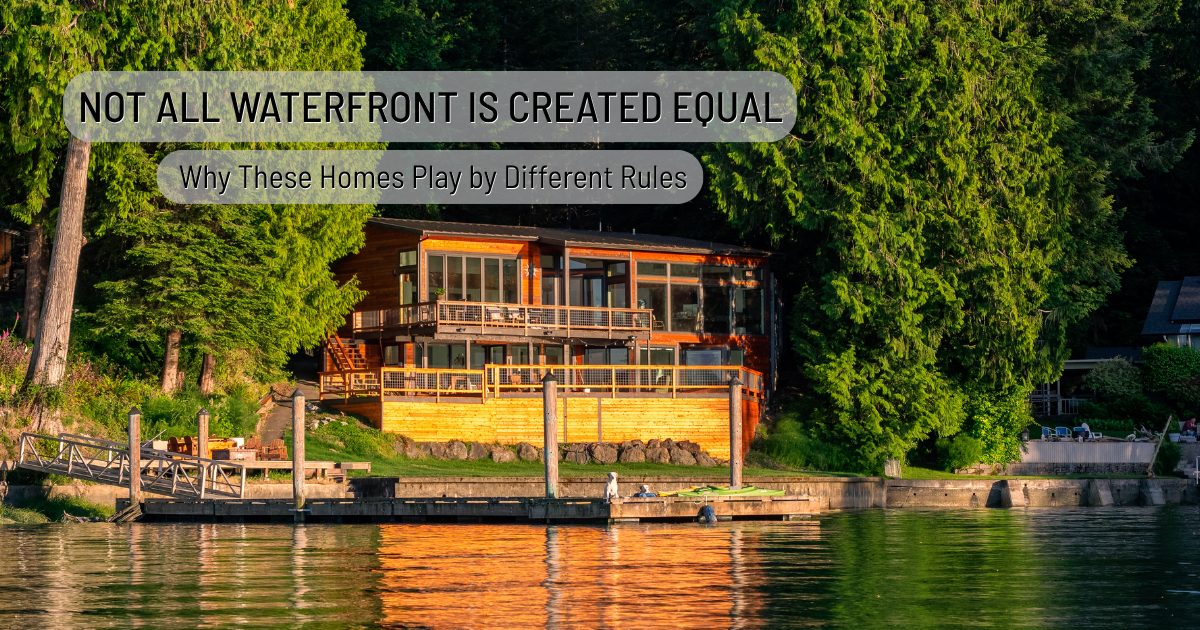
The real estate market can be slow.
That doesn’t necessarily mean waterfront is slow.
I was reminded of that recently while showing waterfront homes around Thurston County. We were looking at a property priced north of $1 million, working through comparable sales, discussing where the value actually landed—and another buyer was waiting outside for their turn to see it.
So much for having the place to ourselves.
That’s the thing about waterfront real estate around Olympia and Thurston County: it’s almost a market within the market.
A buyer might hear that homes are taking longer to sell and assume that means there’s plenty of time to think, negotiate aggressively, and come back next weekend.
Sometimes there is.
Sometimes somebody else is standing in the driveway.
Waterfront Is a Limited Commodity
There are only so many waterfront properties around here.
We aren’t making more shoreline.
And once you narrow the search beyond simply having water somewhere behind the house, the available inventory gets smaller quickly.
Maybe you want Puget Sound rather than lakefront.
Maybe you want low-bank waterfront.
Maybe actual beach access matters.
Maybe you need three bedrooms, a garage, some usable yard, and don’t want to spend the next two years remodeling the house.
Every additional requirement shrinks an already limited pool of properties.
That’s why desirable waterfront can attract attention even when the broader real estate market isn’t particularly exciting.
Not All Waterfront Is Equal
This is where waterfront pricing gets interesting.
Two homes can both have “waterfront” checked in the MLS and offer completely different experiences.
One might have a bulkhead, usable yard, unobstructed views, and stairs leading directly to a beach.
Another might technically reach the water but require walking down a wooded slope to get there.
One property might have a beautiful beach at lower tide.
Another might have considerably more mud than the listing photos suggested.
And then there are properties sitting right on a point or occupying some other unusually desirable piece of shoreline.
Those are difficult to compare because sometimes there simply isn’t another property quite like them.
This is why I don’t like evaluating waterfront based solely on square footage or a price-per-square-foot calculation.
The dirt—and where that dirt meets the water—can be a huge part of the value.
The View Matters
This sounds obvious until you’re comparing properties.
A waterfront home with a broad, unobstructed view is different from one where most of the water is visible through trees.
Orientation matters.
Neighboring homes matter.
Elevation matters.
Even the way the house sits on the property matters.
I’ve walked through perfectly nice waterfront homes where the water almost felt secondary because of the home’s layout. I’ve also walked into relatively modest houses where the first thing you see is an enormous wall of water outside the windows.
Those aren’t the same product.
And buyers don’t react to them the same way.
Low-Bank, High-Bank and Actual Water Access
“Waterfront” doesn’t automatically mean you can walk out the back door and put your feet in Puget Sound.
Western Washington has plenty of high-bank waterfront where the home may sit substantially above the shoreline.
That can provide spectacular views and privacy, but direct water access may be difficult—or nonexistent.
Low-bank waterfront is generally much easier to access, which can make it especially desirable.
Then there’s everything in between.
Stairs.
Trails.
Bulkheads.
Steep slopes.
Tidelands.
Beaches that look dramatically different depending on the tide.
If using the water is important to you, don’t just ask whether the property has waterfront.
Ask what kind of waterfront it has.
Bulkheads and Shoreline Improvements Matter Too
A bulkhead can completely change how a waterfront property functions.
It may affect usable yard space, shoreline access, erosion concerns, and the overall experience of the property.
But waterfront structures also deserve additional investigation.
What’s there now?
What condition is it in?
What maintenance might be coming?
And if you eventually want to change something along the shoreline, what regulations apply?
Washington shoreline properties can involve additional rules and permitting considerations that don’t exist with the house three streets inland.
That doesn’t mean you shouldn’t buy waterfront.
It means don’t assume you can change it later just because you own it.
Comparable Sales Get Weird
This is one of my favorite parts of evaluating waterfront.
You pull comparable sales and initially think you’ve got a nice little group.
Then you actually look at them.
That one’s lakefront.
That one’s saltwater.
That one is low-bank.
That one has no bulkhead.
That one has substantially less usable yard.
That one has a much better house but worse beach access.
That one sits on a point and is basically a unicorn.
Suddenly your neat little spreadsheet needs considerably more context.
That’s why I care about the story behind each comparable sale.
A home’s sold price matters.
Why it sold for that price matters more.
If we’re evaluating a waterfront home, I want to understand how the competing properties actually compare—not just whether they’re within a few miles and have approximately the same number of bedrooms.
Days on Market Can Be Misleading
This is another place buyers can get themselves into trouble.
Suppose the average home in the area is taking 60 or 70 days to sell.
A waterfront property has been listed for a few weeks.
It’s easy to think:
“We’ve got time.”
Maybe.
But county-wide averages include thousands of homes that have absolutely nothing to do with the property you’re standing in.
The better question is:
How many buyers are looking for this particular type of property, and how many legitimate alternatives do they currently have?
If the answer is “several buyers” and “not many alternatives,” the broader market statistics aren’t going to save you.
That doesn’t mean you panic.
It doesn’t mean you waive protections or throw money at the seller.
It means you recognize the property for what it is and make decisions accordingly.
Price Per Square Foot Has Its Limits
I use price per square foot.
It’s useful.
It can help identify patterns and provide another way to compare properties.
But on waterfront, it can also become incredibly misleading if it’s treated as the answer rather than one piece of the analysis.
Imagine two 1,500-square-foot homes.
One has direct beach access, a bulkhead, a beautiful yard, and an unobstructed water view.
The other sits above the shoreline with limited access through trees.
Should they be worth the same amount because the houses are the same size?
Of course not.
The house is part of what you’re buying.
On waterfront, the property itself may be the thing you can never replicate.
You can remodel a kitchen.
You can replace flooring.
You can even substantially change a house.
Moving it onto better waterfront is considerably more difficult.
A Slower Market Doesn’t Mean You Should Move Slowly on the Right House
This is probably the biggest lesson.
I don’t like pressuring buyers.
If you need time to decide whether a house works for you, take the time you need.
But part of my job is also making sure you understand what’s happening around you.
If we’ve found something that checks unusually difficult boxes, the comps support the value, showing activity is strong, and there aren’t five similar properties waiting down the street, I’ll tell you.
That doesn’t mean:
“BUY IT RIGHT NOW.”
It means:
“If you want this one, understand the risk of waiting.”
There’s a difference.
The goal isn’t to make decisions out of fear.
It’s to make them with good information.
Buying Waterfront in Thurston County?
Waterfront shopping around Olympia isn’t just about finding a house with a nice view.
We’re evaluating the house, shoreline, access, beach, topography, improvements, regulations, comparable sales, and how difficult it would be to find another property that offers the same combination.
Sometimes the right answer is to negotiate hard.
Sometimes it’s to wait.
And sometimes it’s recognizing that the house you’re looking at isn’t competing with every other home in Thurston County.
It’s competing with the handful of properties that can offer what it does.
That’s a much smaller market.


