

 Facebook
 X
 Pinterest
 Copy Link
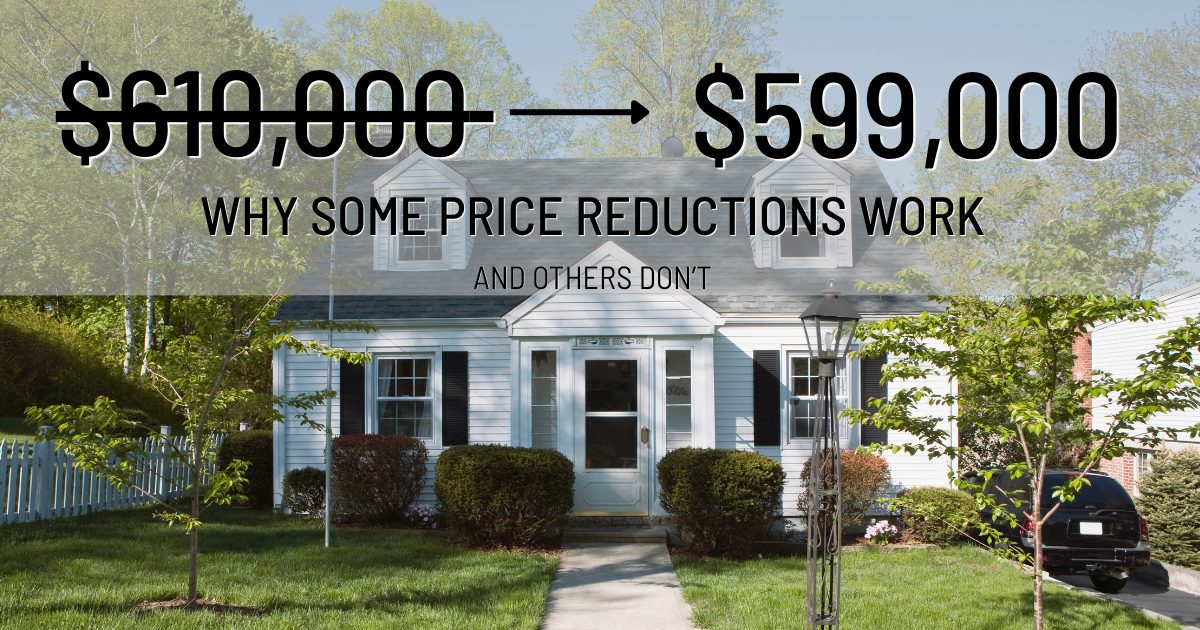
The psychology of pricing, the 5% rule, and why $599,000 might tell a different story than $600,000.
There’s a difference between reducing the price of a house and actually making it more attractive to buyers.
And sometimes, that difference is considerably bigger than sellers realize.
Let’s say your home is listed at $610,000. It’s been on the market for a while, showings have slowed down, and nobody’s writing an offer.
So you reduce the price to $605,000.
Congratulations. You’ve saved the next buyer $5,000.
There’s just one problem.
If buyers already think your house is $40,000 overpriced, that $5,000 reduction probably isn’t going to change their minds.
This is where pricing strategy becomes considerably more important than simply changing the number on the listing.
Why Do Some Price Reductions Fail?
One of the biggest misconceptions about selling a home is that any price reduction should automatically generate renewed interest.
It doesn’t necessarily work that way.
Buyers are constantly comparing properties. They’re looking at square footage, condition, location, amenities, and what else their money could buy.
If your home is priced at $610,000 but competing properties offer similar features for $575,000, reducing your asking price to $605,000 probably doesn’t change that comparison very much.
You’re still competing against the same homes.
You’re still asking buyers to justify the same price difference.
And you may still be sitting outside the price range where your most likely buyers are searching.
A successful price reduction needs to change something about how buyers see the property.
Otherwise, you’ve changed the number without changing the conversation.
The 5% Rule: Why Small Price Reductions Often Fall Flat
There’s a common rule of thumb in real estate that price reductions of less than approximately 5% may not be enough to generate meaningful new interest.
It’s not a universal rule, and there’s no magic percentage that guarantees a home will sell.
But the reasoning is worth understanding.
Let’s take that $610,000 listing.
| New Asking Price | Reduction | Percentage |
|---|---|---|
| $605,000 | $5,000 | 0.8% |
| $600,000 | $10,000 | 1.6% |
| $599,000 | $11,000 | 1.8% |
| $579,000 | $31,000 | 5.1% |
A small reduction might be enough if the property was already priced close to where buyers see its value.
But if the home is substantially overpriced relative to comparable properties, a 1% or 2% adjustment may do very little.
A larger reduction can make buyers reconsider a property they previously dismissed.
That doesn’t mean every seller needs to slash their price by 5%.
It means the size of the adjustment should reflect the problem we’re actually trying to solve.
Why $599,000 Can Feel Different From $600,000
Here’s where pricing psychology gets interesting.
Consider two asking prices:
$600,000
$599,000
They’re separated by just $1,000.
Financially, that difference is relatively insignificant in a transaction of this size.
Psychologically, however, some buyers may perceive them differently.
A price beginning with a five can feel different from a price beginning with a six, even when the actual difference is small.
This is sometimes called left-digit pricing, and it’s one reason you see prices like $499,000, $599,000, and $799,000 throughout real estate.
But there’s another factor worth considering.
How buyers search for homes.
Search Brackets Can Matter More Than Sellers Realize
Most buyers aren’t scrolling through every home for sale in Thurston County.
They’re using filters.
Location. Bedrooms. Bathrooms. Property size. And, importantly, maximum price.
Imagine a buyer whose search is capped at $600,000.
A home listed at $610,000 may not appear in that search.
Reduce it to $600,000, and it potentially becomes visible.
Reduce it to $599,000, and it still fits.
That’s an important distinction.
The move from $610,000 to $600,000 may introduce the property to a new group of buyers, while the additional reduction to $599,000 may primarily affect how the price is perceived.
Of course, different real estate websites use different search filters, and not every buyer searches using the same price increments.
The point isn’t that every home should end in $9,000.
The point is that a price reduction can sometimes accomplish more than changing what the seller receives.
It can change who sees the listing in the first place.
Price Reductions Should Reposition the Property
This is the concept I wish more sellers understood.
When we reduce a listing price, I want that adjustment to accomplish at least one of two things:
- Reach buyers who weren’t seeing the property before. This might mean moving into a different online search bracket or becoming a realistic option for buyers with a lower budget.
- Change how the property compares to its competition. A home that looked overpriced at $610,000 might look much more compelling at $579,000 when compared with similar homes nearby.
Ideally, a price adjustment accomplishes both.
But reducing the price simply because another two weeks have passed?
That’s not much of a strategy.
And repeatedly making tiny reductions can create its own problem.
The Danger of Chasing the Market Down
Imagine a home starts at $650,000.
After several weeks, the seller reduces it to $645,000.
Then $639,000.
Then $629,000.
Then $619,000.
Months later, the home finally reaches a price where buyers begin showing genuine interest.
By that point, however, the listing has accumulated significant days on market, and buyers may be wondering why it hasn’t sold.
Is something wrong with it?
Is the seller difficult?
Has an inspection uncovered something?
Those assumptions aren’t necessarily fair, but buyers make them anyway.
And the seller may now be negotiating from a weaker position than if the home had been priced competitively much earlier.
Sometimes the most expensive pricing mistake isn’t reducing the price too much. It’s waiting too long to make the adjustment that was needed.
Days on Market Don’t Tell the Whole Story
A home sitting on the market for 60 days isn’t automatically overpriced.
Maybe it’s a unique property with a smaller buyer pool.
Maybe it’s acreage, waterfront, luxury, or a home with features that don’t appeal to everyone.
Maybe the local market is simply moving slowly.
That’s why I don’t like using days on market as the only reason to recommend a price reduction.
I want to look at the entire picture.
Are buyers viewing the listing online?
Are they scheduling showings?
What feedback are we receiving?
Have comparable homes sold?
What new competition has entered the market?
Have interest rates or buyer conditions changed?
And perhaps most importantly:
What are buyers choosing instead of this property?
If similar homes are selling while yours isn’t attracting interest, that’s useful information.
If the entire market segment is quiet, we may be dealing with something broader than your asking price.
Those are two very different conversations.
What If Your Home Is Getting Showings but No Offers?
This is another important distinction.
A home receiving very little showing activity may have a visibility problem, a pricing problem, or both.
But a home getting plenty of showings without offers tells us something different.
Buyers are finding it.
They’re interested enough to walk through the door.
Something is happening between that initial interest and the decision to write an offer.
Maybe the condition doesn’t match the price.
Maybe the layout isn’t working for buyers.
Maybe the photos created expectations the property doesn’t meet.
Or maybe buyers simply believe they can get more for their money somewhere else.
The solution isn’t automatically a price reduction.
But if the same objections keep appearing, we need to take them seriously.
The market is giving us feedback. Our job is to listen to it.
Why Pricing Strategy Matters in Olympia and Thurston County
Real estate isn’t one giant, uniform market.
A three-bedroom home in Olympia isn’t necessarily competing with a rural acreage property in Rochester.
A waterfront home near Boston Harbor doesn’t have the same buyer pool as a newer subdivision home in Lacey.
And a property with a large detached shop may appeal to buyers who have very different priorities than someone looking for a low-maintenance home in Tumwater.
That’s why I don’t believe in applying the same pricing formula to every listing.
The appropriate strategy depends on the property, the competition, current buyer activity, and the seller’s goals.
A reduction that makes sense for one property might be completely unnecessary for another.
And sometimes the right advice is to hold the price and improve something else.
The First Price Is Usually the Most Important
Here’s the part nobody particularly enjoys hearing.
The best opportunity to position a home in the market is usually before it goes live.
That’s when the listing is fresh.
That’s when buyers who have been watching the market notice something new.
That’s when your marketing, photography, property preparation, and pricing all come together.
If we launch substantially above what the market supports, we risk wasting some of that initial attention.
And while price reductions can absolutely work, they aren’t always a substitute for getting the strategy right from the beginning.
I would much rather have an informed pricing conversation before listing than spend the next three months explaining why we need to keep adjusting.
Selling Your Home? Let’s Talk About the Strategy, Not Just the Number.
If you’re preparing to sell in Olympia, Lacey, Tumwater, or the surrounding Western Washington communities, pricing should involve more than looking at an online estimate and choosing a number that sounds good.
We need to understand your competition, buyer search behavior, property condition, recent sales, and how your home fits into the market.
And if your home is already listed and isn’t getting the attention it should?
Let’s figure out why before blindly cutting the price.
Because reducing your asking price is easy. Making that reduction accomplish something is where the strategy comes in.


