

 Facebook
 X
 Pinterest
 Copy Link
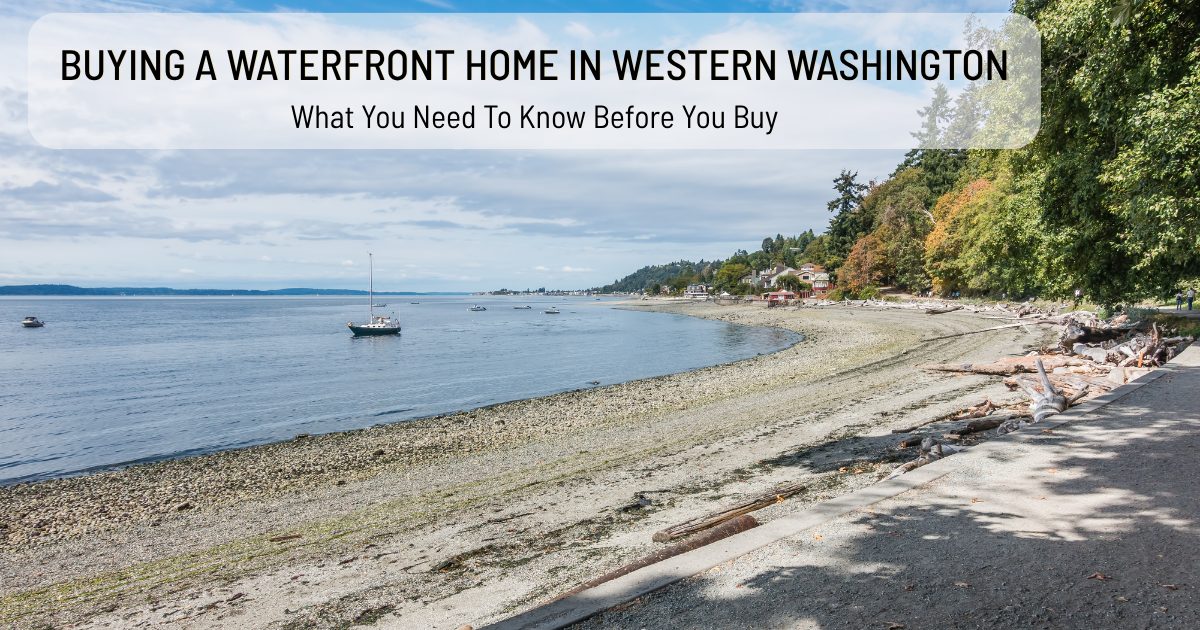
There’s something about waterfront property in Western Washington that’s hard to replicate.
Puget Sound outside your window. A dock out back. Kayaks sitting by the beach. Maybe enough distance from the neighbors that the loudest thing you hear in the morning isn’t traffic.
It’s easy to fall in love with the view.
Just don’t let the view distract you from what you’re actually buying.
Waterfront homes can involve questions that simply don’t exist with a conventional house in a neighborhood. Shoreline regulations, docks, bulkheads, tidelands, flood exposure, erosion, septic systems and insurance can all become part of the transaction.
My advice is pretty simple:
Enjoy the view.
Then start asking questions.
Not All Waterfront Is the Same
“Waterfront” sounds like a property type.
It really isn’t.
A home on Puget Sound is different from a house on a lake. Saltwater shoreline is different from freshwater. High-bank waterfront creates different considerations from a walk-out beach.
Some properties have docks. Some have community waterfront. Some provide water views or nearby access without actually owning shoreline at all.
Even two neighboring waterfront properties can have meaningful differences.
That’s why the first question shouldn’t simply be:
How many feet of waterfront does it have?
It should be:
What exactly comes with this property?
Figure Out What You Actually Own
This is one of the least glamorous—and potentially most important—parts of evaluating waterfront property.
The fact that someone’s lawn ends at the water doesn’t necessarily tell you where their ownership ends.
Washington has a complicated history of public and private ownership involving tidelands, shorelands and aquatic lands. Depending on the individual property and its history, the ownership and rights associated with the land at and below the water can vary.
That can matter if you’re dreaming about modifying a dock, installing something in the water, using the beach or simply understanding exactly what you’re purchasing.
Don’t assume.
Review the title information, legal description, surveys when available, easements and other recorded documents. When the answer isn’t clear, this is where the appropriate title, survey, legal or governmental professionals become important.
With waterfront property, what’s underneath the water can matter just as much as what’s underneath the house.
An Existing Dock Doesn’t Necessarily Mean You Can Do Whatever You Want With It
A dock is an incredible feature.
It’s also a structure sitting in one of the more regulated portions of the property.
Washington shoreline development is governed through a combination of state law and local shoreline regulations. Depending on the location and proposed work, repairing, replacing, enlarging or substantially modifying a dock may require permits or approvals.
So if an existing dock is one of the reasons you’re paying a premium for the property, investigate it during due diligence.
Questions worth asking include:
- Was the existing structure permitted?
- What is its current condition?
- Has it previously been repaired or modified?
- Are records available for previous work?
- What maintenance may be approaching?
- Would your future plans require additional permits or approvals?
Don’t buy based on the assumption that because something exists today, you’ll automatically be allowed to replace or modify it however you want in the future.
Bulkheads Deserve Attention Too
Bulkheads and other shoreline stabilization structures are easy to ignore when they’re doing their job.
They become considerably harder to ignore when they’re failing.
If a property has a bulkhead, retaining structure or other erosion-control feature, look beyond whether it appears good from the deck.
Try to determine its age, construction, condition, maintenance history and whether previous repairs or modifications were properly completed.
And if something looks questionable, a normal home inspection may not provide every answer you need.
Depending on the property and concern, a marine, geotechnical, structural or shoreline professional may be appropriate.
The point isn’t that every waterfront buyer needs a small army of consultants.
It’s knowing when something has moved beyond the expertise of a general home inspection.
Shoreline Rules Can Affect Future Plans
This is one of the biggest reasons to investigate a waterfront property beyond the house itself.
Local shoreline regulations can affect what can be built or changed near regulated waterways. Depending on the property and jurisdiction, things like additions, decks, docks, shoreline stabilization, vegetation, septic systems and other improvements may face additional requirements.
That matters even if you have absolutely no intention of changing the property today.
Because someday you might.
If you’re buying waterfront with plans to remodel, add a structure, replace a dock or substantially alter the property, investigate whether those plans appear feasible before you buy.
Finding out afterward tends to be the more expensive version of that conversation.
Waterfront Doesn’t Automatically Mean Flood Zone
And being outside a designated high-risk flood area doesn’t mean flooding is impossible.
Look at the actual property rather than making assumptions based simply on its proximity to water.
Elevation matters. Drainage matters. The type of waterfront matters. So does the location of the house relative to the shoreline.
Insurance should be investigated early as well.
Typical homeowners insurance generally doesn’t cover flood damage, so waterfront buyers should discuss the property’s specific risks, coverage options and potential costs with a qualified insurance professional.
That’s not something I’d leave until three days before closing.
High-Bank Waterfront Adds Another Question: What’s Holding the Hill Up?
Some of Western Washington’s most spectacular waterfront views come from high-bank properties.
That also means the house may be sitting above a significant slope.
Drainage, erosion, vegetation and slope stability can therefore become important considerations.
A beautiful bluff overlooking Puget Sound deserves the same treatment as the dock:
Admire it.
Then investigate it.
Typical homeowners policies also generally exclude landslide or earth-movement damage, making both the physical condition of the property and available insurance coverage worth understanding.
If the property has a steep slope, visible erosion, unusual drainage, retaining structures or anything else that raises concern, appropriate professional evaluation may be money very well spent.
Septic Systems Become Especially Important Near the Water
Many waterfront homes outside urban areas use onsite septic systems.
That’s completely normal.
But the system deserves attention.
Understand where the tank and drainfield are located, what type of system it is, its maintenance and inspection history and whether the system could affect future remodeling or expansion plans.
A beautiful waterfront lot can have surprisingly little flexibility once you account for the existing house, shoreline requirements, septic system, reserve area and other development constraints.
Again, you’re not simply buying a house with a view.
You’re buying an entire collection of systems and limitations that happen to occupy a very desirable piece of dirt.
“Private Beach” Can Mean Different Things
Terms like “private beach,” “beach rights,” “community waterfront,” “tidelands” and “water access” can describe very different arrangements.
Don’t rely on the marketing language alone.
Determine what rights are actually conveyed with the property and where those rights come from.
Is the waterfront actually part of the parcel?
Is access provided through an easement?
Does an HOA or community own the beach?
Are tidelands included?
Are there shared docks or other facilities?
Are there agreements governing their use and maintenance?
This is where title documents, surveys, recorded easements, HOA documents and other property records become considerably more interesting than the listing description.
Waterfront Can Be Harder to Value
Waterfront properties don’t always provide the neat comparable sales we’d love to have.
One home may have low-bank access while another sits high above the water. One may have a usable dock. Another may have substantially more shoreline. One might have a spectacular western exposure while another has completely different water access or views.
Condition, privacy, beach type, access, improvements and how usable the waterfront actually is can all influence how buyers perceive value.
That’s particularly important when you’re buying or selling a higher-end or distinctive waterfront home.
Sometimes the best comparable isn’t the house three doors down.
Understanding why buyers paid what they did for other waterfront properties can be just as important as the sale prices themselves.
Your Normal Home Inspection May Only Be the Beginning
A general home inspection remains important.
But depending on the property, waterfront due diligence might also involve:
- Septic inspection
- Well or water-system evaluation
- Sewer scope
- Dock or pier evaluation
- Bulkhead or shoreline-structure evaluation
- Geotechnical or slope assessment
- Survey or boundary review
- Flood and insurance research
- Permit and development-history research
- Title review involving tidelands, easements or access rights
Not every waterfront property needs every item on that list.
That’s the entire point of due diligence.
Figure out what’s unusual about this particular property, then investigate accordingly.
The Best Waterfront Property Isn’t Necessarily the Prettiest One
This may be the hardest part.
Waterfront homes can be emotional purchases.
You walk through the house, step onto the deck, see Puget Sound stretching out in front of you and immediately start imagining coffee in the morning and a boat tied up outside.
That’s part of why people buy them.
But a great waterfront purchase is more than a great view.
It’s a property where you understand what you own, what you can do with it, what you’re responsible for maintaining and what risks come with the location.
The goal isn’t to talk yourself out of buying waterfront.
It’s to know what you’re buying before you fall so completely in love with the view that you stop asking questions.
Thinking About Buying Waterfront in Western Washington?
Western Washington offers everything from Puget Sound and Hood Canal waterfront to lakes, rivers and smaller bodies of water—and each property can come with its own considerations.
If waterfront is part of your search, start with what you actually want from it.
Do you need a dock?
Do you want low-bank beach access?
Are you primarily looking for the view?
Do you want enough water for boating?
How important are privacy, acreage or proximity to town?
Those answers help narrow the search considerably.
If you’re also considering the Olympia and South Puget Sound area, I put together a broader guide to moving to Olympia, Washington that covers housing, commuting, rural properties and what living here is actually like.
From there, we can worry about finding the right waterfront house.
And then we’ll investigate the hell out of everything attached to the water.
Nate Wright
Real Estate Broker
CENTURY 21 Van Dorm Realty
Olympia, Washington


